
Classic Beef Wellington Recipe – Perfect Centerpiece for Special Dinners
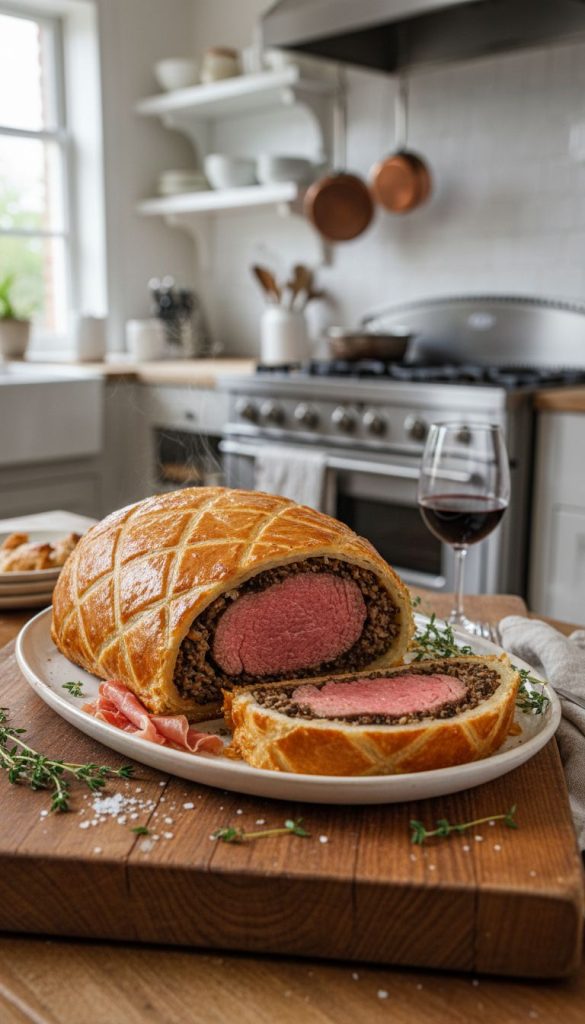
Beef Wellington has a way of stopping conversation the moment it reaches the table. The golden, flaky puff pastry, the aroma of savory mushrooms, and the promise of perfectly cooked, tender beef inside make it one of those dishes that feels like a celebration all on its own. Even though it looks impressive and restaurant-worthy, this version is completely doable at home with a bit of care and a clear plan.
In this recipe, you will wrap a seasoned, seared beef tenderloin in a rich mushroom and onion mixture, layer it with delicate prosciutto, and then cocoon everything in crisp puff pastry. The result is a showstopping centerpiece that is perfect for holidays, special dinners, or any evening when you want to make people feel truly spoiled. Along the way, you will see that each step is straightforward, and by the time you slice into your first Beef Wellington, you will feel proud of every moment you spent bringing it together.
- What Makes This Beef Wellington So Special
- Gathering Your Ingredients for Beef Wellington
- Step-by-Step Walkthrough to Crafting Beef Wellington
- Timing and Preparation: From Start to Finish
- Nutritional Overview for This Beef Wellington
- Common Questions About Making Beef Wellington
- Closing Thoughts on Serving Beef Wellington
- Classic Beef Wellington
What Makes This Beef Wellington So Special
This Beef Wellington stands out because it balances elegance with comfort. The beef tenderloin is seasoned simply with fine sea salt and freshly ground black pepper, then seared in olive oil to build deep flavor and a beautiful crust. A layer of mushroom duxelles, made from cremini mushrooms, yellow onion, garlic, dry white wine, and fresh thyme, adds a savory, aromatic richness that keeps the meat moist and flavorful.
Prosciutto wraps around the beef and mushroom mixture, helping to keep everything snug and adding a gentle, salty note. Finally, a sheet of puff pastry encases the whole log, brushed with egg wash and dusted with flaky sea salt before baking. As it bakes, the pastry turns crisp and golden while the beef inside stays tender and juicy. The combination of textures — crisp pastry, silky mushrooms, and soft, perfectly cooked beef — is what makes every slice feel like something truly special.
Gathering Your Ingredients for Beef Wellington
Before you start cooking, it helps to have everything measured and ready. Here is what you will need, along with how each ingredient supports the final dish:
- 2 lb beef tenderloin, center-cut – The star of the dish, tender and mild, perfect for staying juicy inside the pastry.
- 1 1/2 tsp fine sea salt – Seasons the beef thoroughly and brings out the natural flavors in every layer.
- 1 tsp freshly ground black pepper – Adds a gentle heat and depth to the seared crust of the tenderloin.
- 2 tbsp olive oil – Used to sear the beef, helping it develop a flavorful, browned exterior.
- 2 tbsp unsalted butter – Enriches the mushroom mixture and helps it cook down to a silky, flavorful base.
- 1 tbsp Dijon mustard – Brushed over the warm beef to add a tangy, savory note that cuts through the richness.
- 1 lb cremini mushrooms, finely chopped – Form the heart of the mushroom duxelles, bringing deep, earthy flavor.
- 1 small yellow onion, finely chopped – Adds sweetness and body to the mushroom mixture as it cooks down.
- 2 cloves garlic, minced – Provides aromatic depth and a gentle, savory bite to the filling.
- 1/4 cup dry white wine – Deglazes the pan, lifts browned bits, and brightens the mushroom mixture.
- 1 tsp fresh thyme leaves, chopped – Brings a fresh, herbal note that complements both the mushrooms and beef.
- 8 slices prosciutto – Wraps around the beef and mushrooms, adding salty flavor and helping keep everything in place.
- 1 sheet puff pastry, thawed but chilled – Encloses the entire log and bakes into a golden, flaky crust.
- 1 large egg – Beaten into an egg wash to give the pastry a glossy, deep golden finish.
- 1 tbsp water – Mixed with the egg to thin the egg wash for easier brushing.
- 1 tsp flaky sea salt, for topping – Sprinkled on top of the pastry for a subtle crunch and extra burst of flavor.
Step-by-Step Walkthrough to Crafting Beef Wellington
Beef Wellington is all about timing and layering. Take it step by step, and you will find it flows naturally:
- Season the beef tenderloin. Pat the beef tenderloin dry with paper towels so it sears properly. Sprinkle it all over with the fine sea salt and freshly ground black pepper, pressing lightly so the seasoning adheres.
- Sear the beef for flavor and color. Heat the olive oil in a large skillet over medium-high heat until it shimmers. Add the beef tenderloin and sear it on all sides, including the ends, until well browned, about 2 to 3 minutes per side. This step locks in juices and builds a flavorful crust.
- Brush with Dijon mustard. Transfer the seared beef to a plate and let it cool just slightly. While it is still warm, brush the entire surface with the Dijon mustard. Set the beef aside to cool completely; this helps keep the pastry from becoming soggy later.
- Start the mushroom mixture. In the same skillet, reduce the heat to medium and add the unsalted butter. Once melted and foaming, add the finely chopped cremini mushrooms and yellow onion.
- Cook down the vegetables. Stir the mushrooms and onion often, allowing their moisture to release and evaporate. Continue cooking until the mixture is soft, reduced, and beginning to brown slightly. This concentration of flavor is key.
- Add garlic for aroma. Stir in the minced garlic and cook for about 30 seconds, just until fragrant. Be careful not to let it brown too much, as that can add bitterness.
- Deglaze with white wine. Pour in the dry white wine and use a wooden spoon to scrape up any browned bits from the bottom of the skillet. These bits carry a lot of savory flavor.
- Finish with thyme and reduce fully. Sprinkle in the chopped fresh thyme leaves and continue cooking, stirring frequently, until the wine has completely evaporated and the mushroom mixture is dry and spreadable. This dryness helps keep the pastry crisp.
- Cool the mushroom mixture. Transfer the mushroom mixture to a plate or shallow dish and let it cool completely to room temperature. Warm filling can soften the puff pastry too quickly, so give it time.
- Prepare the prosciutto layer. Lay a sheet of plastic wrap on your work surface, slightly longer than the beef. Arrange the prosciutto slices on the plastic wrap in a slightly overlapping rectangle large enough to wrap around the tenderloin.
- Spread the mushroom mixture. Once the mushroom mixture is cool, spread it evenly over the prosciutto, pressing it gently so it adheres and forms a thin, uniform layer.
- Wrap the beef in prosciutto and mushrooms. Place the cooled, mustard-coated beef tenderloin along one long edge of the prosciutto and mushroom rectangle. Using the plastic wrap to help you, roll everything up tightly into a log so the prosciutto and mushrooms completely surround the beef.
- Chill the wrapped beef. Twist the ends of the plastic wrap to secure the log firmly, then place it in the refrigerator for at least 20 to 30 minutes. This helps it firm up and hold its shape for wrapping in puff pastry.
- Prepare the puff pastry. On a lightly floured surface, roll out the chilled puff pastry sheet, if needed, into a rectangle large enough to fully enclose the beef log with a little overlap.
- Position the beef on the pastry. Remove the wrapped beef log from the refrigerator and carefully unwrap it. Place it in the center of the puff pastry, with the long side of the beef parallel to the long side of the pastry.
- Make the egg wash. In a small bowl, whisk together the egg and water until smooth. This egg wash will help seal the pastry and give it a glossy, golden finish.
- Wrap the beef in puff pastry. Brush a thin layer of egg wash along the edges of the puff pastry. Fold the pastry snugly over the beef log, pressing the seams together to seal. Trim any excess if needed, then fold the ends under so the beef is fully enclosed.
- Transfer and glaze the Wellington. Carefully flip the wrapped Beef Wellington so the seam side is down and place it on a parchment-lined baking sheet. Brush the entire surface generously with more egg wash.
- Add salt and a decorative pattern. Lightly sprinkle the top with the flaky sea salt. Using the tip of a sharp knife, gently score a decorative pattern on the pastry, taking care not to cut all the way through.
- Chill while preheating the oven. Place the baking sheet with the assembled Beef Wellington in the refrigerator for about 15 minutes. Meanwhile, preheat your oven to 400°F (200°C). This brief chill helps the pastry hold its shape.
- Bake to golden perfection. Transfer the baking sheet to the preheated oven and bake for about 30 to 35 minutes, or until the puff pastry is deep golden brown. An instant-read thermometer inserted into the center of the beef should read about 125°F (52°C) for medium-rare.
- Rest before slicing. Remove the Beef Wellington from the oven and let it rest on the baking sheet for 10 to 15 minutes. This resting time allows the juices in the beef to redistribute, giving you cleaner slices.
- Slice and serve. Transfer the rested Beef Wellington to a cutting board. Using a sharp serrated knife, slice it into thick portions, revealing the layers of pastry, prosciutto, mushrooms, and perfectly cooked beef. Serve immediately while the pastry is still crisp.
Timing and Preparation: From Start to Finish
This Beef Wellington involves several stages, but each one is manageable when you know what to expect. You will need about 45 minutes of active preparation time to season and sear the beef, cook the mushroom mixture, assemble the layers, and wrap everything in puff pastry. There are also short resting and chilling periods that work in your favor, giving you natural breaks in the process.
Plan on roughly 20 to 30 minutes of chilling time after wrapping the beef in prosciutto and mushrooms, plus another 15 minutes of chilling once the Wellington is wrapped in puff pastry. The baking time is about 30 to 35 minutes at 400°F (200°C), followed by a final 10 to 15 minutes of resting after it comes out of the oven.
You will know the Beef Wellington is ready to enjoy when the puff pastry is a deep, even golden brown and crisp, and an instant-read thermometer inserted into the center of the beef reads around 125°F (52°C) for a medium-rare result. After resting, the internal temperature will rise slightly, and the slices will be juicy, tender, and beautifully layered.
Nutritional Overview for This Beef Wellington
Because Beef Wellington is rich and celebratory, it is best enjoyed as the centerpiece of a special meal. The following values are approximate and based on one serving when the recipe is divided into six portions:
- Calories: about 720 kcal
- Protein: around 43 g
- Carbohydrates: about 23 g
- Fat: roughly 49 g
- Saturated Fat: about 19 g
- Sodium: approximately 1320 mg
- Fiber: around 2 g
- Sugars: about 3 g
These numbers will vary slightly depending on the exact puff pastry and prosciutto you use, but they provide a helpful snapshot. Serving this Beef Wellington with lighter sides, such as simply cooked vegetables or a crisp salad, can balance the richness and make the meal feel satisfying without being overwhelming.
Common Questions About Making Beef Wellington
Can I prepare Beef Wellington ahead of time?
Yes, you can prepare the Beef Wellington up to the point where it is fully wrapped in puff pastry and brushed with egg wash. Once assembled, keep it refrigerated on a parchment-lined baking sheet for a few hours before baking. For best texture, it is ideal to bake it the same day you assemble it, so the puff pastry stays light and crisp.
How do I avoid a soggy bottom on the pastry?
The key is to cook the mushroom mixture until it is very dry and to let both the beef and the mushroom mixture cool completely before wrapping. Chilling the prosciutto-wrapped beef helps as well. These steps ensure that excess moisture does not seep into the puff pastry while it bakes.
What if I prefer my beef more well done?
If you like your beef more cooked, you can bake the Wellington a little longer, checking the internal temperature with an instant-read thermometer. Keep in mind that the beef will continue to cook slightly as it rests, so remove it from the oven a few degrees before your target doneness to avoid overcooking.
Closing Thoughts on Serving Beef Wellington
There is something deeply satisfying about bringing a homemade Beef Wellington to the table. From seasoning and searing the beef tenderloin to layering the mushroom mixture, prosciutto, and puff pastry, every step feels like an act of care. When you slice through the golden crust and reveal the rosy beef and savory filling inside, you see the payoff for your patience and attention.
This is the kind of dish that invites people to linger at the table a little longer, to take a second slice, and to talk about how good it tastes. Whether you are making it for a holiday, a special celebration, or simply to treat the people you love, this Beef Wellington has a way of turning an ordinary evening into something memorable. With this guide in hand, you can approach the recipe with confidence, knowing that each step leads you closer to a beautiful, delicious centerpiece that you will be proud to serve.
Classic Beef Wellington
Ingredients
- 2 lb beef tenderloin, center-cut
- 1 1/2 tsp fine sea salt
- 1 tsp freshly ground black pepper
- 2 tbsp olive oil
- 2 tbsp unsalted butter
- 1 tbsp Dijon mustard
- 1 lb cremini mushrooms, finely chopped
- 1 small yellow onion, finely chopped
- 2 cloves garlic, minced
- 1/4 cup dry white wine
- 1 tsp fresh thyme leaves, chopped
- 8 slices prosciutto
- 1 sheet puff pastry, thawed but chilled
- 1 large egg
- 1 tbsp water
- 1 tsp flaky sea salt, for topping
Instructions
- Pat the beef tenderloin dry with paper towels, then season it all over with the fine sea salt and freshly ground black pepper, pressing the seasoning gently into the meat.
- Heat the olive oil in a large skillet over medium-high heat until shimmering, then add the beef tenderloin and sear on all sides, including the ends, until well browned, about 2 to 3 minutes per side.
- Transfer the seared beef tenderloin to a plate and let it cool slightly, then brush the warm surface all over with the Dijon mustard and set aside to cool completely.
- In the same skillet, reduce the heat to medium, add the unsalted butter, and once melted, add the finely chopped cremini mushrooms and yellow onion.
- Cook the mushroom and onion mixture, stirring often, until most of the moisture has evaporated and the vegetables are soft and beginning to brown.
- Stir in the minced garlic and cook for about 30 seconds until fragrant, then pour in the dry white wine and scrape up any browned bits from the bottom of the skillet.
- Add the chopped fresh thyme leaves and continue cooking the mixture, stirring frequently, until the wine has completely evaporated and the mushroom mixture is dry and spreadable.
- Transfer the mushroom mixture to a plate or shallow dish and let it cool completely to room temperature before assembling the Beef Wellington.
- Lay a sheet of plastic wrap on a work surface, slightly longer than the beef, and arrange the prosciutto slices on it in a slightly overlapping rectangle large enough to wrap around the tenderloin.
- Spread the cooled mushroom mixture evenly over the prosciutto layer, pressing it gently so it adheres and forms a thin, even coating.
- Place the cooled, mustard-coated beef tenderloin along one long edge of the prosciutto and mushroom layer, then use the plastic wrap to help roll it up tightly into a log.
- Twist the ends of the plastic wrap to secure the roll firmly, then refrigerate the wrapped beef log for at least 20 to 30 minutes so it can firm up.
- On a lightly floured surface, roll out the chilled puff pastry sheet, if needed, into a rectangle large enough to fully encase the beef log with a small overlap.
- Remove the wrapped beef log from the refrigerator, unwrap it, and place it in the center of the puff pastry, positioning it so the long side of the beef is parallel to the long side of the pastry.
- In a small bowl, whisk together the egg and water to make an egg wash, then brush a thin layer of the egg wash along the edges of the puff pastry.
- Fold the puff pastry snugly over the beef log, pressing the seams together to seal and trimming any excess pastry if needed, then fold the ends under to fully enclose the beef.
- Carefully flip the wrapped Beef Wellington over so the seam side is down, place it on a parchment-lined baking sheet, and brush the entire surface with more egg wash.
- Sprinkle the top lightly with the flaky sea salt, then use the tip of a sharp knife to score a gentle decorative pattern on the pastry without cutting all the way through.
- Refrigerate the assembled Beef Wellington on the baking sheet for about 15 minutes while you preheat the oven to 400°F (200°C).
- Bake the Beef Wellington in the preheated oven for about 30 to 35 minutes, or until the puff pastry is deep golden brown and an instant-read thermometer inserted into the center of the beef reads about 125°F (52°C) for medium-rare.
- Remove the Beef Wellington from the oven and let it rest on the baking sheet for 10 to 15 minutes so the juices can redistribute before slicing.
- Transfer the rested Beef Wellington to a cutting board and use a sharp serrated knife to slice it into thick portions, then serve immediately while the pastry is still crisp.