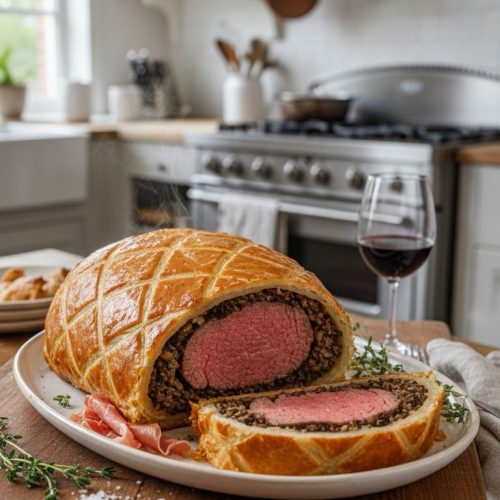
Classic Beef Wellington
A tender beef tenderloin wrapped in savory mushroom duxelles and golden puff pastry, perfect as an impressive centerpiece for special occasions.
Ingredients
- 2 lb beef tenderloin, center-cut
- 1 1/2 tsp fine sea salt
- 1 tsp freshly ground black pepper
- 2 tbsp olive oil
- 2 tbsp unsalted butter
- 1 tbsp Dijon mustard
- 1 lb cremini mushrooms, finely chopped
- 1 small yellow onion, finely chopped
- 2 cloves garlic, minced
- 1/4 cup dry white wine
- 1 tsp fresh thyme leaves, chopped
- 8 slices prosciutto
- 1 sheet puff pastry, thawed but chilled
- 1 large egg
- 1 tbsp water
- 1 tsp flaky sea salt, for topping
Instructions
- Pat the beef tenderloin dry with paper towels, then season it all over with the fine sea salt and freshly ground black pepper, pressing the seasoning gently into the meat.
- Heat the olive oil in a large skillet over medium-high heat until shimmering, then add the beef tenderloin and sear on all sides, including the ends, until well browned, about 2 to 3 minutes per side.
- Transfer the seared beef tenderloin to a plate and let it cool slightly, then brush the warm surface all over with the Dijon mustard and set aside to cool completely.
- In the same skillet, reduce the heat to medium, add the unsalted butter, and once melted, add the finely chopped cremini mushrooms and yellow onion.
- Cook the mushroom and onion mixture, stirring often, until most of the moisture has evaporated and the vegetables are soft and beginning to brown.
- Stir in the minced garlic and cook for about 30 seconds until fragrant, then pour in the dry white wine and scrape up any browned bits from the bottom of the skillet.
- Add the chopped fresh thyme leaves and continue cooking the mixture, stirring frequently, until the wine has completely evaporated and the mushroom mixture is dry and spreadable.
- Transfer the mushroom mixture to a plate or shallow dish and let it cool completely to room temperature before assembling the Beef Wellington.
- Lay a sheet of plastic wrap on a work surface, slightly longer than the beef, and arrange the prosciutto slices on it in a slightly overlapping rectangle large enough to wrap around the tenderloin.
- Spread the cooled mushroom mixture evenly over the prosciutto layer, pressing it gently so it adheres and forms a thin, even coating.
- Place the cooled, mustard-coated beef tenderloin along one long edge of the prosciutto and mushroom layer, then use the plastic wrap to help roll it up tightly into a log.
- Twist the ends of the plastic wrap to secure the roll firmly, then refrigerate the wrapped beef log for at least 20 to 30 minutes so it can firm up.
- On a lightly floured surface, roll out the chilled puff pastry sheet, if needed, into a rectangle large enough to fully encase the beef log with a small overlap.
- Remove the wrapped beef log from the refrigerator, unwrap it, and place it in the center of the puff pastry, positioning it so the long side of the beef is parallel to the long side of the pastry.
- In a small bowl, whisk together the egg and water to make an egg wash, then brush a thin layer of the egg wash along the edges of the puff pastry.
- Fold the puff pastry snugly over the beef log, pressing the seams together to seal and trimming any excess pastry if needed, then fold the ends under to fully enclose the beef.
- Carefully flip the wrapped Beef Wellington over so the seam side is down, place it on a parchment-lined baking sheet, and brush the entire surface with more egg wash.
- Sprinkle the top lightly with the flaky sea salt, then use the tip of a sharp knife to score a gentle decorative pattern on the pastry without cutting all the way through.
- Refrigerate the assembled Beef Wellington on the baking sheet for about 15 minutes while you preheat the oven to 400°F (200°C).
- Bake the Beef Wellington in the preheated oven for about 30 to 35 minutes, or until the puff pastry is deep golden brown and an instant-read thermometer inserted into the center of the beef reads about 125°F (52°C) for medium-rare.
- Remove the Beef Wellington from the oven and let it rest on the baking sheet for 10 to 15 minutes so the juices can redistribute before slicing.
- Transfer the rested Beef Wellington to a cutting board and use a sharp serrated knife to slice it into thick portions, then serve immediately while the pastry is still crisp.